


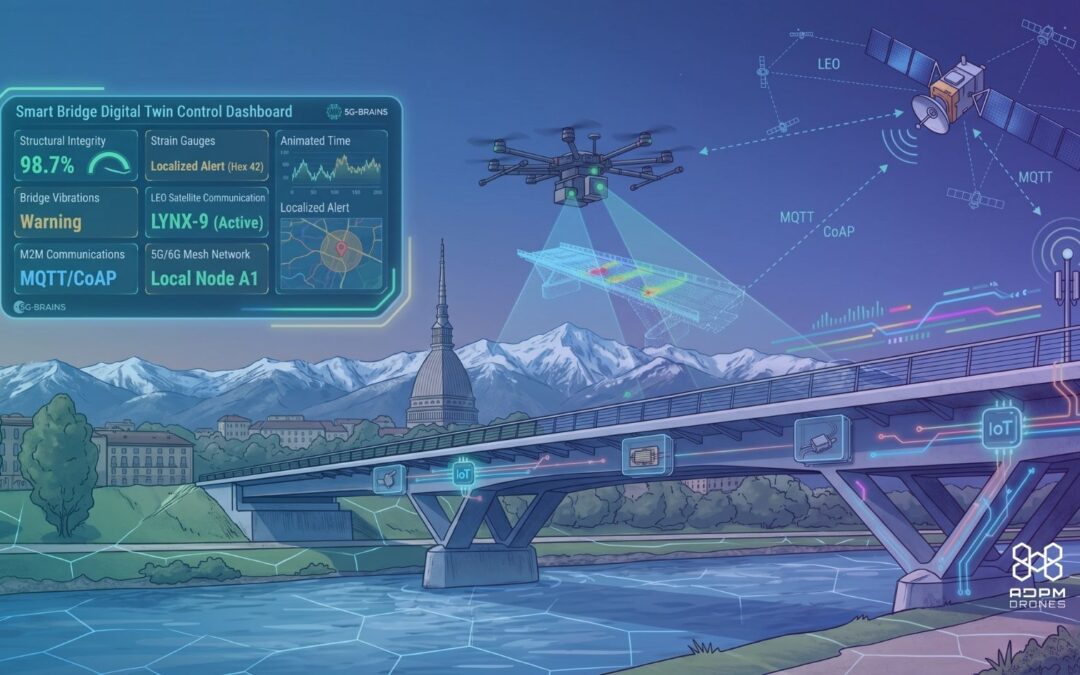
Italy, with its vast and historic infrastructure heritage, faces a crucial challenge: ensuring the maximum safety of its bridges and viaducts. In Turin, this challenge is finding an unprecedented technological response thanks to the 5G-BRAINS project, an initiative that marks the definitive transition from reactive maintenance (based on periodic visual inspections) to continuous, intelligent, and predictive monitoring.
The 5G-BRAINS Project: A “Neural Network” for Infrastructure
Currently in an advanced testing phase on two strategic bridges in Parco Dora (Corso Umbria and Via Livorno), 5G-BRAINS is being developed by an all-Italian consortium of excellence. It is led by Eagleprojects, alongside prominent companies such as ADPM Tech, Gisky, Yottametro, and the Eucentre research center.
The project, with a total value of €600,000, also carries significant weight at the European level, boasting a substantial co-financing of €400,000 from the European Space Agency (ESA), which is highly interested in the integration of satellite data for urban safety.
But how exactly does this platform work? Imagine equipping bridges with an actual “nervous system.” State-of-the-art devices – including accelerometers, strain gauges, inclinometers, and thermometers – are installed at key points on the infrastructure to measure structural conditions 24/7. If a bridge vibrates more than usual, undergoes deformations, or experiences millimeter-scale micro-movements (detected by antennas similar to a smartphone’s GPS), the data is instantly transmitted to the operational headquarters located at the Museo A come Ambiente.
To avoid bottlenecks or signal interruptions, the system is hyper-connected via 5G networks and satellite links. Here, Artificial Intelligence takes over: it aggregates and analyzes massive amounts of data, creating an always-updated “Digital Twin” (a 3D digital replica) of the infrastructure.
The Key Role of Drones and the “On-Demand” Approach
What happens when the platform detects a suspicious anomaly? The system doesn’t just send a simple notification to the engineers; it triggers an actual visual rapid response.
This is where the drones from ADPM come into play. The aircraft – which take off directly from the Museum’s terrace – perform on-demand flights to the affected area, instantly providing ultra-high-resolution images of the potential critical issue. In addition to emergency response, the drones carry out regular scheduled flights for the photogrammetric updating of the bridge, working in synergy with space satellites (used to monitor if the surrounding ground is moving, revealing any potential subsidence).
As pointed out by Luca Brizzi, CEO of ADPM: > “The true strength of the system is that all this information is brought together: these are not separate checks, but data that talk to each other and allow us to immediately identify any anomalies.” The goal is clear: to intervene before the anomaly becomes a real danger.
Turin: An Ecosystem for Innovation
Turin’s vocation as an open-air laboratory for Smart Cities does not end with 5G-BRAINS. The city is looking with interest at an ecosystemic approach. Recent developments, in fact, see the Piedmontese capital as a partner in another European project (called CAPRI, also supported by ESA) aimed at the automated inspection of bridges. This parallel initiative pushes the development of drones equipped with artificial intelligence for autonomous flight and ultra-high-precision inspections in the lower layers of the bridges (the intrados), where traditional satellite signals are often absent.
The Future of Urban Safety
The benefits of this integrated approach (IoT Sensors + AI + Drones + Satellite Data) are multiple:
-
Prevention of collapses thanks to a predictive rather than reactive approach.
-
Cost optimization compared to manual inspections at heights using aerial work platforms.
-
Zero traffic disruption: drones eliminate the need to close roads and divert traffic to carry out checks.
By the summer, the City of Turin will formally decide whether to definitively adopt the 5G-BRAINS system. If the safe management of our territory relies on the digital transition, Turin has already taken the right path. And it’s traveling it by flying.